



CSR Code
Our commitment
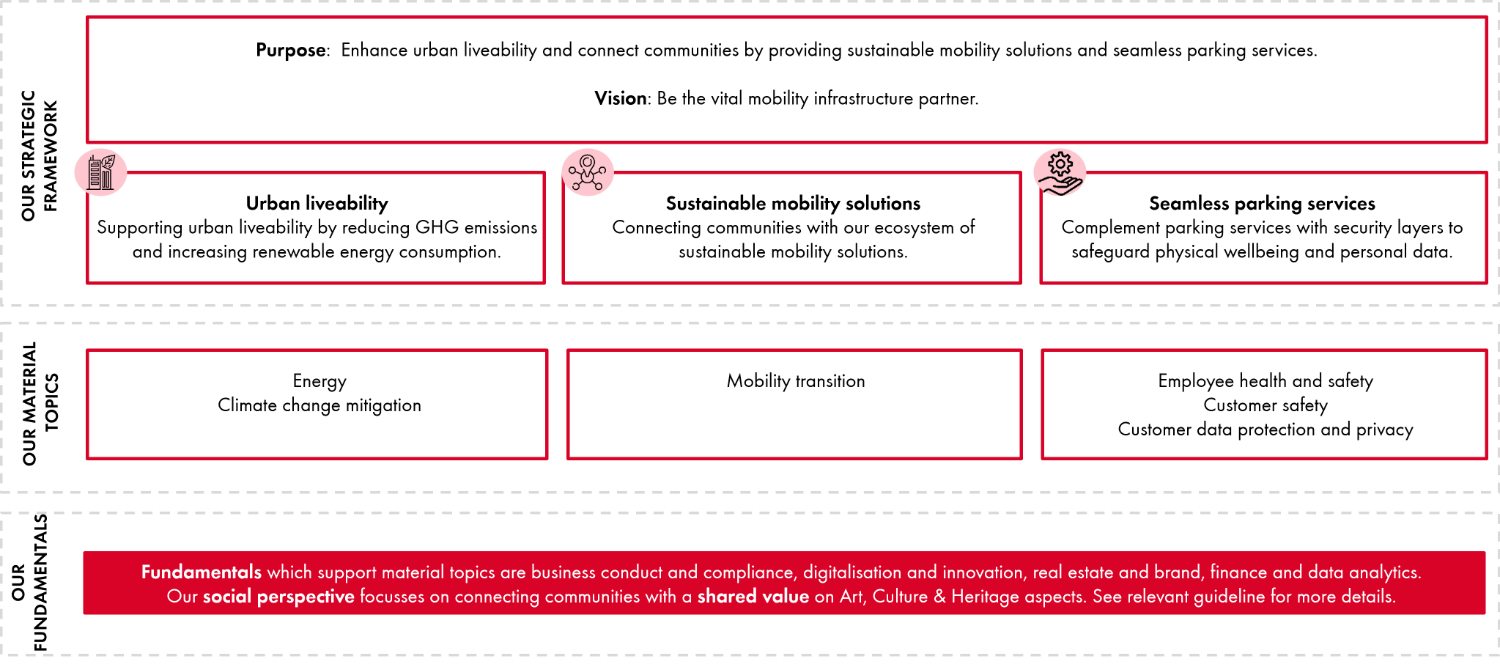
Q-Park is an international parking owner and operator with a clear role in the cities and communities we serve. We provide parking facilities and mobility services that help people access city centres, hospitals, shopping areas, offices, transport nodes and other important destinations. Our purpose is to enhance urban liveability and connect communities by providing sustainable mobility solutions and seamless parking services. Our ambition is to be the vital mobility infrastructure partner.
Corporate Social Responsibility is part of how we do business. For Q-Park, CSR means taking responsibility for the environmental, social and governance (ESG) impacts of our activities, while managing the risks and opportunities that influence our long-term value creation. It guides how we invest, operate, innovate, report and collaborate with customers, employees, partners, investors, public authorities and communities.
Our CSR Code sets out the principles that guide our decisions and behaviour. It supports our long-term business strategy, our commitment to quality in parking, and our contribution to sustainable, accessible, liveable and economically vital urban environments.
Our basis for responsible business conduct
Compliance with applicable laws and regulations is the minimum standard. Our ambition is to go further where we can, by integrating CSR considerations into business decisions, operational improvements and stakeholder dialogue.
We define sustainable development in line with the widely used Brundtland definition: development that meets the needs of the present without compromising the ability of future generations to meet their own needs. This principle remains relevant to Q-Park because our business sits at the intersection of mobility, urban space, energy use, safety, digitalisation and long-term infrastructure management.
How CSR supports our business goals
CSR is aligned with Q-Park’s business goals because the topics that matter most to society are also increasingly important to our operational resilience, reputation, customer trust and long-term competitiveness. Our 2026 double materiality assessment (DMA) confirmed that climate change mitigation and energy, mobility transition, employee health and safety, customer safety, and customer data protection and privacy are material topics for Q-Park.
This means that CSR is not treated as a separate activity. It supports business goals in several ways:
stronger operational performance: energy-efficient technologies such as LED lighting, motion detection and solar panels can reduce electricity consumption and operating costs.
future-ready services: mobility hubs, EV charging and partnerships with shared mobility providers help Q-Park respond to changing mobility patterns and create services beyond traditional parking.
trusted customer experience: clean, safe, accessible and easy-to-use parking facilities strengthen the Q-Park brand and support our commitment to quality in parking.
resilient organisation: attention to employee health, safety and wellbeing helps protect our colleagues and support business continuity.
digital confidence: customer data protection and privacy are essential to maintaining trust in our increasingly digital services.
credible stakeholder dialogue: transparent CSR reporting helps Q-Park explain its impact, progress and priorities to investors, public authorities, commercial partners, employees and customers.
Our material CSR topics
Q-Park periodically assesses which material topics are most relevant to our business and stakeholders. In 2026, Q-Park updated its DMA with support from ERM. The assessment reviewed our business context, value chain, stakeholder input, sector developments, peer practices and relevant European Sustainability Reporting Standards (ESRS).
The assessment confirmed three material topics from the previous assessment:
Climate change mitigation and energy: Q-Park uses energy to operate parking facilities and offices. Reducing greenhouse gas emissions, improving energy efficiency and increasing the use of renewable energy are therefore important areas for action. Energy efficiency also supports operational performance by helping to reduce exposure to rising energy costs.
Mobility transition: Q-Park contributes to the mobility transition by supporting EV charging, mobility hubs, shared mobility and better integration with public transport and other transport modes. These services help customers make smarter mobility choices and support cities in managing accessibility, liveability and public space more effectively.
The 2026 assessment also identified three newly material topics:
Employee health and safety: Q-Park employees may be exposed to physical hazards, aggression or stressful situations in parking operations and enforcement activities. Protecting employee health, safety and wellbeing is therefore an important responsibility and a material topic for Q-Park.
Customer safety: Parking facilities must be safe, accessible and well-managed. Customer safety is fundamental to Q-Park’s license to operate and directly linked to the quality of our parking facilities and services.
Customer data protection and privacy: Digital parking services require the responsible handling of customer data. Safeguarding personal and payment information is essential to customer trust, regulatory compliance and the continued development of digital services.
Our CSR principles
Q-Park applies the following CSR principles across the organisation.
We act responsibly and transparently: We comply with applicable laws, regulations, policies and internal standards. We conduct business with integrity and expect our employees, suppliers and partners to act responsibly. We report on our CSR performance annually and provide stakeholders with relevant information about our progress, challenges and priorities.
We support sustainable urban mobility: Q-Park believes that well-managed parking is part of sustainable urban mobility. Regulated parking, off-street parking facilities, mobility hubs, EV charging and digital parking information can help cities manage traffic flows, reduce unnecessary search traffic and improve the use of public space.
We reduce environmental impact: We aim to improve the environmental performance of our parking facilities (PFs) , fleet and offices. We focus on energy efficiency, renewable energy, greenhouse gas emissions, smart technologies and operational improvements that help reduce our environmental footprint.
We put safety first: We work to provide safe PFs for customers and safe working conditions for employees. This includes attention to PF design, maintenance, inspections, security measures, training, incident prevention and continuous improvement.
We protect data and digital trust: We recognise that digital services create responsibilities as well as opportunities. Q-Park is committed to protecting customer data, respecting privacy and strengthening cybersecurity practices across our organisation.
We create practical value for communities: PFs are often the first or last part of a visitor’s journey. Clean, safe, attractive and well-located PFs contribute to the quality of urban destinations and help connect people with work, healthcare, retail, leisure, culture and public transport.
We engage with stakeholders: We maintain dialogue with country organisations, employees, public authorities, commercial partners, investors, shareholders, mobility partners and other relevant stakeholders. Their expectations and insights help us improve our services, identify risks and opportunities, and make more informed decisions.
CSR governance
Responsibility for Q-Park’s CSR policy and implementation lies with the Executive Board. Q-Park has a CSR Committee that advises the Executive Board on CSR policy, priorities, stakeholder involvement and reporting. The CEO chairs this committee.
The Head of CSR is responsible for monitoring CSR developments, coordinating the CSR reporting process, supporting consistent data gathering and helping countries and business units understand and improve performance. The CEO and country managing directors are responsible for the result-oriented execution of the policy in their respective areas.
The CSR Committee also validates key CSR priorities and materiality outcomes. In 2026, Q-Park’s CSR Committee reviewed and validated the findings of the updated double materiality assessment, including the material topics and impacts, risks and opportunities identified.
CSR remuneration
Q-Park believes that sustainable business performance is achieved through a balanced focus on financial and non-financial results. Our remuneration philosophy therefore supports the long-term interests of the company, its stakeholders and the communities in which we operate.
The Executive Board oversees the integration of sustainability considerations into corporate strategy, risk management and performance management. Where appropriate, non-financial performance indicators may be incorporated into management objectives and performance assessments alongside financial indicators. These indicators are aligned with Q-Park's material sustainability topics, including climate change mitigation and energy, mobility transition, employee health and safety, customer safety, and customer data protection and privacy.
Through this approach, Q-Park seeks to encourage behaviours and decisions that support sustainable value creation, operational excellence, responsible business conduct and long-term business resilience. Remuneration policies are periodically reviewed to ensure they remain aligned with the company's strategy, governance framework and evolving stakeholder expectations.
Reporting and accountability
Q-Park publishes an Annual CSR Report to provide insight into our CSR ambitions, activities, performance and progress. The report is intended for customers, employees, shareholders, banks, business partners, suppliers, public authorities, communities and other stakeholders.
Our annual CSR reporting is increasingly informed by the outcomes of our double materiality assessment. This helps ensure that our reporting focuses on the sustainability matters that are most relevant to Q-Park’s impacts, risks, opportunities (IROs) and long-term value creation.
Q-Park reports on environmental, social and governance (ESG) topics and continues to improve data quality, definitions, internal controls and reporting processes. The CSR Reporting Manual describes the use of standardised data collection, reporting definitions and country-level data gathering. These foundations remain important as Q-Park prepares for CSRD reporting requirements, i.e. the sustainability statement in the Annual Report 2027.
The 2026 double materiality assessment (DMA) provides an important foundation for determining the relevant scope of future disclosures.
Scope and boundary
To date, the Annual CSR Reports concern Q-Park BV and relevant group companies in so far as they are majority holdings, in line with the scope applied in our corporate reporting. Q-Park reports on topics where it has direct influence and material impact, while also recognising that some effects occur across the wider value chain.
Data is gathered from the countries in which Q-Park operates and from the holding company. The reporting process uses standardised definitions and data collection methods to improve completeness, consistency and reliability. Where estimates or expert judgements are used, this is disclosed as part of the reporting methodology.
Continuous improvement
CSR is a continuous improvement process. Q-Park will continue to refine its policies, targets, data, reporting and stakeholder engagement as our business evolves and as sustainability expectations develop.
Our focus is practical and long term: to make our parking facilities safer, our operations more efficient, our services more sustainable, our reporting more transparent and our organisation more resilient. In doing so, Q-Park aims to create shared value for customers, employees, partners, investors, cities and communities.