


Funding storm ahead
Why public transport funding is tightening - and where public transport authorities (PTAs) and public transport operators (PTOs) can find new action levers
(Source: Report 2026 by Arthur D. Little and Polis)
Executive summary
Public transport and shared mobility systems face an unprecedented funding challenge at a time when they are expected to deliver more than ever. On one hand, demand for sustainable and inclusive mobility is rising, and governments have set ambitious goals for modal shift, fleet decarbonisation, and resilient infrastructure by 2050. On the other hand, traditional funding models are struggling to keep up.
Despite these headwinds, expectations for the mobility sector are higher than ever. Urban populations continue to grow (the United Nations projects an additional 2.5 billion urban residents by 2050, mostly in emerging economies) and with them the demand for transport infrastructure and services. Policymakers in urban areas are also urging a rapid modal shift away from private cars toward public, shared, and active modes to meet climate targets and reduce congestion.
Yet progress has been slow: over the past 15 years, the combined global share of trips by public transport, walking, cycling, and new mobility services increased from roughly 20% to about 30% of urban trips. But they remain almost stable when it comes to kilometers traveled (passengers per kilometer, or pax-km), where private cars still account for ~70% of urban pax-km worldwide (even higher in many suburban and rural areas), according to the Arthur D. Little (ADL) “The Future of Mobility 5.0” report.
In addition, the transport sector is not doing enough to reduce CO2 emissions, as the 2015 Paris Agreement target (+1.5°C) was reached last year. The continuous growth of road transport, still largely led by internal combustion engine (ICE) vehicles, is the major driver of these emissions, and car occupancy rate remains low (~1.5 people per car in OECD [Organisation for Economic Co-operation and Development] countries). Furthermore, this has negative impacts on cities (e.g., congestion, urban sprawl, accidents).
Given the massive funding needs fueled by climate change and modal shift policies, what is the size of the gap for public transport by 2035 and 2045? How can we efficiently and pragmatically bridge the gap using both short-term solutions and long-term programmes?
Key findings
Over the next 10 years Europe will face rising demand alongside evolving environmental and resilience requirements.
Over the next 10 years — and even more so by 2050 — Europe will face rising demand alongside evolving environmental and resilience requirements. Without significantly higher spending, PTAs will not be able to close that funding gap.
The research estimates the total spending for public transport in Europe (excluding Russia and Turkey) at ~€130 billion yearly, of which ~€96 billion is OPEX only. There are three main funding sources for mobility:
Fare revenues (paid by users) account for ~44% of OPEX on average (~27% of total spending, including CAPEX).
Subsidies, tax schemes, public compensation, and earmarked taxes (paid by taxpayers) help fill the funding gap.
Direct non-fare revenues (e.g., real estate, retail, advertising, consulting) usually account for less than 5% of the total budget.
Estimates of the funding shortfall underscore the magnitude of the challenge. We estimate that, on average, yearly spending could grow by +13% in OPEX and +56% in CAPEX. Additional spending over the period will increase the budget by +36% yearly in total (~€153 per capita per year). The four dimensions are:
Hidden debt
Climate change resilience
Fleet electrification
Modal shift through network and service expansion
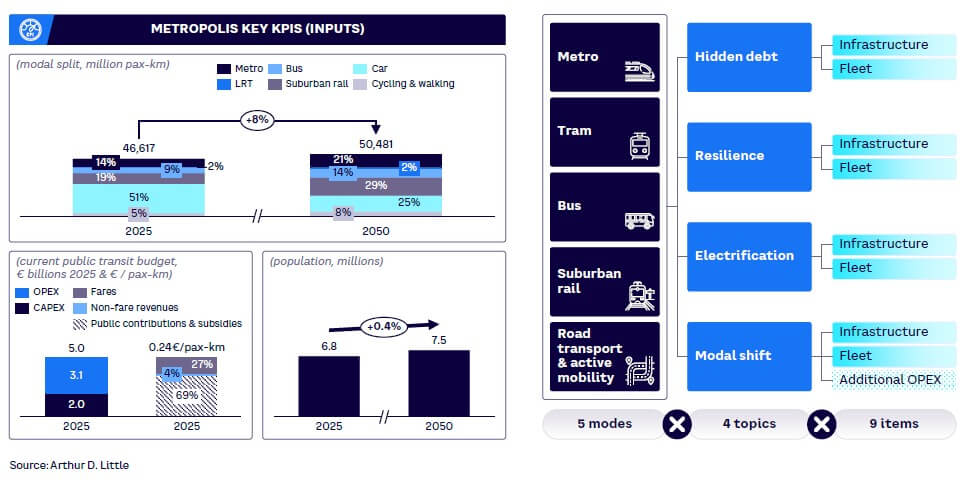
The research resulted in five key findings:
In the Metropolis model, the four dimensions are not equal; electrification (which is currently the primary focus of many policymakers) will yield high levels of resilience at relatively low cost.
High-capacity modes such as metro and suburban rail will make up more than 80% of the needed funding in the next 10–20 years, mainly due to the large projects needed to adapt the existing infrastructure to climate change.
60% of additional spending will go toward network/service expansion (which, ultimately, is a political decision), but the other 40% of investment needs are not optional. They should be funded to maintain the network at the same level of standards, or PTAs should accept a quantitative/qualitative reduction in service in the coming years.
All available levers — from increasing revenues to improving cost per passenger — should be leveraged at the same time, as none is enough to move the needle on its own.
Huge investments in infrastructure, technology, and upskilling will be needed.
The 2050 funding imperative
To understand how mobility funding must evolve, we must understand the scale of investment required across various dimensions. PTAs will need to finance four critical transitions over the coming decades:
Hidden debt (6% of additional funding needs) — investments on legacy assets needed to absorb ageing infrastructure.
Climate change adaptation and resilience (32% of funding needs) — upgrading infrastructure to protect it against climate-related incidents and other shocks.
Fleet electrification/decarbonisation (2% of additional funding needs) — replacing or retrofitting vehicles and equipment to eliminate fossil fuels.
Modal shift and network coverage expansion (60% of funding needs [both CAPEX and OPEX increase]) — scaling up public and shared mobility to significantly reduce car dependence, including service improvements in both cities and less dense areas. Modal shift is also needed to reduce congestion, which creates high costs for cities.
Absorbing hidden debt
Decades of deferred maintenance have created a sizable state of good repair (SGR) backlog in mature networks, especially in rail. This hidden debt spans life-expired track, power and signaling, outdated station systems, and assets no longer compliant with current safety and accessibility standards. Left unaddressed, it reduces reliability, causes speed restrictions, and inflates corrective maintenance costs — undermining climate resilience and modal shift plans.
The first step is to focus on fixing the basics, including track and civil works (bridges, tunnels), power telecoms and signaling, stations and depots, and core road assets.
Investing in resilient, climate-proof infrastructure
Transport infrastructure worldwide is already feeling the impacts of climate change. Extreme weather events that were once rare are becoming more frequent and severe — from flash floods inundating metro lines and highways to heat waves causing rails to expand and overhead cables to sag.
Many urban transit systems, especially older ones, were not designed with these extremes in mind. Rail and metro networks often lack adequate drainage or pump capacity for heavy downpours, and road pavement can degrade faster in high temperatures.
Beyond physical damage, impact on operations includes more frequent service disruptions, slower speeds, and higher deterioration levels on vehicles and infrastructure, all of which translate to higher OPEX.
Transitioning to green fleets
This means a wholesale shift to zero-emission vehicles and equipment over the next two decades. Buses, coaches, municipal vehicle fleets, and even regional trains currently running on diesel must transition to electric or other zero-carbon energy.
Many governments have set targets; some European countries mandate that all new urban buses be zero-emission by 2025 or 2030, and the EU is considering requiring all cities to have 100% zero-emission bus fleets by 2035.
The mobility energy transition requires parallel investment in infrastructure and energy systems. Every electric bus or train requires a reliable source of clean electricity. This means reinforcing the grid (many transit depots need new high-voltage connections), deploying thousands of charging stations (depot chargers and possibly en route fast chargers for buses), and ensuring a reliable renewable energy supply. In some cases, new depots or storage facilities will be needed to house e-bus fleets.
Accelerating modal shift
Building resilient infrastructure and switching to clean vehicles are critical first steps, but sustainable mobility hinges on moving a much larger share of people by public and shared transport. This means significant investments in capacity and quality: more routes, higher frequencies, better intermodal integration, and better coverage of underserved areas. Focus should be on two areas:
Urban and suburban areas — cities and their immediate peripheries, where there is baseline public transport that may need expansion.
Smaller cities, towns, and peri-urban/rural areas (not covered in this report) — where cars dominate and innovative approaches are needed.
The modal share of public transport is directly linked to the level of service
In large urban areas, one might assume public transport is already ubiquitous, but many cities need to significantly expand and upgrade their networks to meet future demand. The modal split of cars is still ~60%–70% of pax-km, including in larger urban areas in 2023.
The ADL/POLIS mobility study found that implementing a suite of measures could potentially double the share of sustainable mobility from ~30% to ~60% pax-km in the next decade, but this would involve, among other things, a major uplift in mass transit provision. The modal share of public transit is directly linked to the level of service.
There is room for large network-improvement projects, especially in metro and suburban trains. Cities should also increase frequency on existing lines (which may require more vehicles and staff), improve connectivity (e.g., better integration between modes, more mobility hubs, more park-and-ride facilities at city borders), and enhance service quality (e.g., newer rolling stock, real-time arrival/departure information, reliability improvements).
These will require capital investment (modern control systems, depot upgrades) and additional operational capabilities.
Strategic levers to address mobility funding gap
Faced with the financial needs outlined, mobility leaders must deploy a range of strategic levers to improve the financial sustainability of transport systems.
Increasing top-line revenues — generating more income from users or taxpayers
Exploring non-fare revenues — unlocking complementary funding sources beyond fares
Improving efficiency and cost-effectiveness at the system level — getting more output from each euro spent to stretch current funds
Conclusion
Overcoming mobility funding challenges is a multifaceted endeavor. It is not just a matter of finding more money. Our recommendations focus on policy paradigm shifts (i.e., questioning long-held assumptions to unlock bold actions), strengthening collaboration and governance between transport authorities and operators (and across government levels), and embedding sustainability metrics (e.g., carbon emissions) into funding decisions to attract new sources and ensure long-term viability.
One of the biggest barriers to solving the funding problem is conventional thinking or treating paradigms as permanent. To enable change, leaders must be willing to challenge the status quo in several areas:
Pricing. There is often a public expectation that public transport should be cheap or even free, while driving and parking are often subsidised or underpriced. This needs reexamination. A new social contract might mean acknowledging that high-quality mobility has a cost — but that cost is worth paying for collectively. Using price signals, such as appropriate fares and road tolls, offers a triple benefit: financing the system, managing demand, and encouraging users to better understand the cost of mobility.
Coverage. Not every neighbourhood needs a direct route to downtown. Given the constrained funding future, agencies must optimise networks for efficiency and impact — which could include changing underperforming services and reallocating resources (e.g., a shift to demand-responsive transport [DRT]).
Integration. Transport, urban planning, energy, and finance often operate in silos. The future calls for integrated thinking, meaning that land use, mobility funding, climate policy, and transport investment should all be connected. Viewing mobility as an integrated ecosystem can unlock significant efficiencies. Improvements in one part of the system (e.g., cycling infrastructure) can reduce costs in another (e.g., road expansion). Even institutional silos created by legislation or competitive regulatory frameworks should be open to reexamination, as breaking down these barriers can create significant value across the system.
Building strong PTA-PTO partnerships
Effective funding solutions require seamless collaboration between entities that plan and fund services (PTAs) and those that deliver the services (PTOs, either municipal or private). In many cases, these entities have a contractual relationship, but fostering a deeper partnership can unlock efficiencies and innovation:
Align objectives and incentives. Contracts and governance structures should ensure that both PTAs and PTOs have skin in the game to improve financial outcomes.
Work jointly on business cases for new funding. For example, if a congestion charge is proposed, the PTA and PTO should together plan how transit will absorb new riders and how funds will be used to scale up service.
Enhance data and transparency. Collaboration is enhanced by sharing data openly (e.g., on costs, ridership patterns). A PTA should know the true cost drivers for the PTO, and the PTO should understand the PTA’s budget constraints. By analysing data together, they can identify problem areas (e.g., routes with exceptionally high subsidies per passenger) and develop more efficient solutions, such as replacing underused fixedroute bus services with demand-responsive transit (DRT) where appropriate.
We recommend pursuing integrated governance at the metro/regional level, so funding levers like road pricing or employer contributions can be applied region-wide and the benefits shared. Some regions have created metropolitan transport authorities with taxing power; these models pool resources to avoid harmful fragmentation.
Find the full report here.